
 bearoff
Are the dice rigged? Why rolls feel unfair online
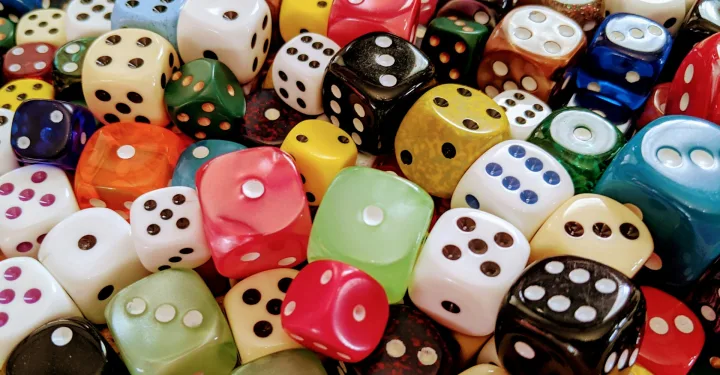
Three double sixes in a row, all theirs. Are they really this lucky? Everyone who plays dice games has had the same thought at some point and come out at: surely not.
It’s a good question, and the honest answer involves some surprising numbers. Here’s how rolls actually behave, why they feel the way they do, and how ours are made.
You remember their good rolls, not yours
When your opponent rolls double sixes at the worst possible moment, that goes in the memory. When you rolled double fives twenty minutes earlier and quietly won a point from it, that doesn't.
Losses are more memorable than wins, and dice give losses something to blame. It's the same instinct that makes everyone say the other queue is moving faster. Why we blame the dice goes further into that.
Streaks are what randomness looks like
Random doesn't mean evenly spread. Over 36 rolls you'd expect each number to turn up 11 times, but any individual stretch will be lumpy: four sixes in a row, then none for ten rolls.
A game of backgammon only contains about forty rolls between the two players. That's a very small sample, and small samples are where strange-looking runs live. If you played a thousand games the lumps would even out, which is exactly the point made in luck vs skill: one game tells you almost nothing.
The odds aren't what people assume
A lot of the feeling of unfairness comes from expecting the wrong numbers in the first place.
Any specific number appears in 11 of the 36 rolls, so about 30% of the time, not the one-in-six people assume. Doubles come up once every six rolls, which feels like a lot when they're not yours. And a lone checker six pips away gets hit by 17 of the 36 rolls, so leaving one is roughly a coin flip rather than bad luck.
Once the real odds are in your head, a lot of "impossible" rolls turn out to be perfectly ordinary.
Good players do seem luckier
They are, in one sense: they arrange positions where more numbers help them.
If eleven rolls out of 36 win you the game and you've also left no shots, you'll look fortunate most of the time. That isn't luck, it's shot counting, and it's learnable. The player who leaves a checker six away and gets hit isn't unlucky either.
How bearoff's dice are made
The server rolls, not your device: one throw for both players, so neither of you can tamper with it and you can never see different numbers.
Each die is a separate draw from the same randomness a computer uses to make encryption keys. There's no seed, so there's no sequence to predict, and no shortcut that quietly favours some faces: all six are exactly equally likely. Nothing looks at who's winning, and the roller isn't even told whose turn it is.
One thing to be straight about. We don't publish a cryptographic receipt for each roll, which is the only way to prove to a sceptic that a particular roll wasn't tampered with afterwards. What we do is keep a signed record of every roll, and you can see it in your game history, including how many doubles each of you rolled.
Fair dice don’t feel fair. They just are.
The short version
- You remember their good rolls, not your own.
- Streaks are normal. Forty rolls is a tiny sample.
- Any specific number: 11 of 36 rolls, about 30%. Doubles: 1 in 6.
- A checker six pips away is hit by 17 of 36 rolls. That isn't bad luck.
- Strong players create positions where more numbers help them.
- The dice are server-rolled, drawn from encryption-grade randomness, and nothing looks at the score.
Fancy a game?
No password, no download - and your opponent can take their turn tomorrow.
Play in your browser
Angela
One of the top 10 sweetest people, probably. German by birth, delightfully unserious by nature. By day, she shapes stories; by night, she beats her boyfriend at backgammon and writes poetry.