
 bearoff
What's the best first move in backgammon?
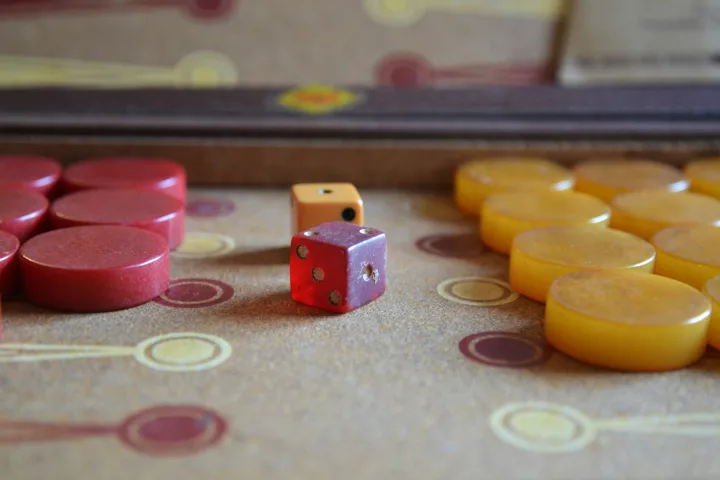
The one roll everyone agrees on, and what to do with the other fourteen.
The board is set up, your opponent has gone quiet, and you're looking at your first roll with no idea what a normal move looks like. Here's the good news: people with powerful computers have studied the opening roll for decades, so you don't have to work it out yourself.
Here's the better news: there are only 15 first rolls, and a handful of ideas cover most of them.
Why there are only 15
To decide who starts, each player rolls one die. The higher number goes first and plays both numbers. If you both roll the same, you roll again.
That means you can never start with doubles, which leaves 15 possible opening rolls. It's a short enough list to get familiar with, even if you play once a week.
The best opening roll is 3-1
If you roll 3-1, make your 5-point. In backgammon notation, that's 8/5, 6/5: one checker moves from the 8-point to the 5-point, and another from the 6-point to the 5-point. Two checkers land on the same point, which means the point is yours and nothing is left exposed.
The 5-point is sometimes called the golden point, and it earns the name. It blocks your opponent's escape route, gives your own checkers a safe landing spot and stops your opponent settling there.
This is the one opening roll that every strong player plays the same way. No debate, no alternatives.
Three more rolls that make a point
The same idea covers three more rolls:
- 4-2: make the 4-point (8/4, 6/4)
- 5-3: make the 3-point (8/3, 6/3)
- 6-1: make the bar point, the one right next to your opponent's home board (13/7, 8/7)
The pattern is simple: if you can make a point without leaving a lone checker behind, do it.
6-5: run for it
Roll 6-5 and you can move one back checker the whole way around to safety in one go: 24/13. It has a name, the lover's leap, and it saves you the slow business of rescuing that checker later.
Everything else: split or build
The remaining rolls can't make a point, so you have two reasonable plans.
Split: move one of your back checkers a short way, so it has a better chance of escaping or settling next turn. With 5-4, that's 24/20, 13/8.
Build: bring two checkers down from your 13-point, ready to make a point next turn. With 4-3, that's 13/10, 13/9.
These are closer calls, and the experts have changed their minds over the years. The best play for 6-4 and 2-1 is still argued about in backgammon clubs. If you like a plan, play it.
The cheat sheet
| Roll | Play | What it does |
|---|---|---|
| 3-1 | 8/5, 6/5 | Makes the 5-point. The best roll. |
| 4-2 | 8/4, 6/4 | Makes the 4-point. |
| 5-3 | 8/3, 6/3 | Makes the 3-point. |
| 6-1 | 13/7, 8/7 | Makes the bar point. |
| 6-5 | 24/13 | Runs a back checker to safety. |
| 4-3 | 13/10, 13/9 | Two builders for next turn. |
| 5-4 | 24/20, 13/8 | Split and build. |
| 5-1 | 24/23, 13/8 | Split and build. |
| 4-1 | 24/23, 13/9 | Split and build. |
| 3-2 | 24/21, 13/11 | Split and build. |
| 5-2 | 24/22, 13/8 | Split and build. |
| 6-2 | 24/18, 13/11 | Split and build. |
| 6-3 | 24/18, 13/10 | Split and build. |
| 6-4 | 24/18, 13/9 | Split and build, or make the 2-point (8/2, 6/2). Still argued about. |
| 2-1 | 13/11, 24/23 | Split, or slot the 5-point (13/11, 6/5). Also argued about. |
Keep rolling
The first roll is the one moment when the dice haven't spoiled anything yet, so it's worth knowing. But nobody loses a game at move one.
Learn the four rolls that make a point, remember the leap, and play the rest by feel. Your next 30 moves will matter more, and by then you'll be making it up anyway, the same as everyone else.
Fancy a game?
No password, no download - and your opponent can take their turn tomorrow.
Play in your browser
Angela
One of the top 10 sweetest people, probably. German by birth, delightfully unserious by nature. By day, she shapes stories; by night, she beats her boyfriend at backgammon and writes poetry.