
 bearoff
Why does the backgammon board bend back on itself?
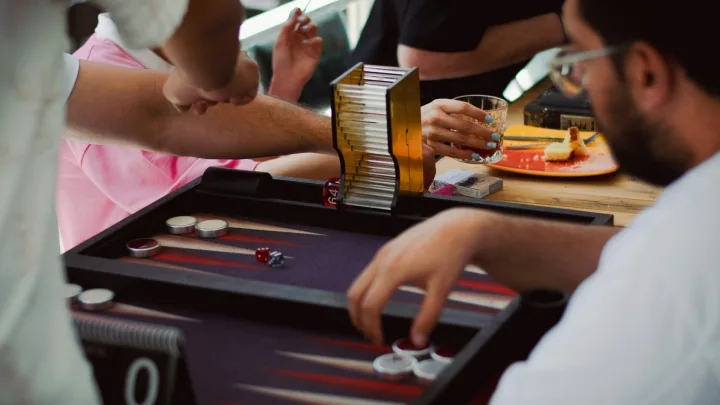
Why do your checkers go down one side and back up the other, instead of in a straight line?
It's a fair question, and one most players never ask. Your checkers travel down one side of the board, round the end and back up the other, like a running track folded in half. Why not just lay the whole route out in one straight line of 24 points and be done with it?
You could, and the game would play exactly the same. The bend is about the furniture, not the rules.
What the board actually is
Twenty-four points, twelve on each side, split into four groups of six. Those groups are the quadrants, and they're why the thing is called a "tables" board: each quadrant is a table.
Your checkers move anticlockwise towards your home board. Your opponent's move clockwise towards theirs. Same points, opposite directions.
A straight board would play the same way
Because you and your opponent travel in opposite directions, your paths cross. You're moving through the territory they're trying to leave, and they're moving through yours. That overlap is where everything interesting happens: hitting, blocking, building a wall in front of their back checkers, waiting on an anchor for a shot.
So picture those 24 points laid out in a single row, with you starting at one end and your opponent at the other, each heading for the end behind the other. Your paths still cross. Hitting still works. Every decision is the same one you'd make on a real board. And that is exactly what our board is: one straight run of 24 points, folded once in the middle, so that point 1 finishes up next to point 24.
So why fold it?
Not for any reason that changes a move. Being hit would cost you just as much on a straight board: your opponent's back checkers start in your home board whatever shape it is, because that comes from the rules. What folding buys is comfort.
Folded, the route sits in four blocks of six, which makes a position readable at a glance: you can see a wall forming, or judge how far a checker still has to travel, without following a long line. It also brings both home boards to the same end of the board, each one in front of the player using it, which is handy in a game that finishes in a flurry.
And it shuts like a case
Twenty-four points in a line would need a board a metre long. The same points in two rows of twelve fit on something that folds in half, with the checkers and dice inside.
Backgammon has travelled for centuries: Rome, Persia, Byzantium, coffee houses everywhere. A board you can shut and carry is part of why.
The shape is older than the game
The Romans played ludus duodecim scriptorum, the game of twelve lines, on three rows of twelve points, with players moving in opposite directions. Drop the middle row and you have two rows of twelve: the board we use now.
That became tabula, the first game clearly recognisable as backgammon's ancestor, which already had hitting and bearing off. So the layout has been settled for something like 1,500 years, and the direction of travel for longer still.
Why twelve points a row, rather than ten or fourteen? Nobody really knows. Six is the obvious unit for a game played with dice, and two sixes make a side that fits a folding board, but that's reasoning after the fact.
The short version
- You and your opponent move in opposite directions.
- Those opposite directions make your paths overlap, and the overlap is the game.
- A straight board would play identically, as long as you start at opposite ends.
- Folding buys comfort, not advantage: four blocks of six you can read at a glance, and your home board in front of you.
- Two rows of twelve fit in a box you can carry.
- The Romans used three rows of twelve. Remove the middle one and you have today's board.
Fancy a game?
No password, no download - and your opponent can take their turn tomorrow.
Play in your browser
Angela
One of the top 10 sweetest people, probably. German by birth, delightfully unserious by nature. By day, she shapes stories; by night, she beats her boyfriend at backgammon and writes poetry.