
 bearoff
Why We Get Competitive With Our Friends
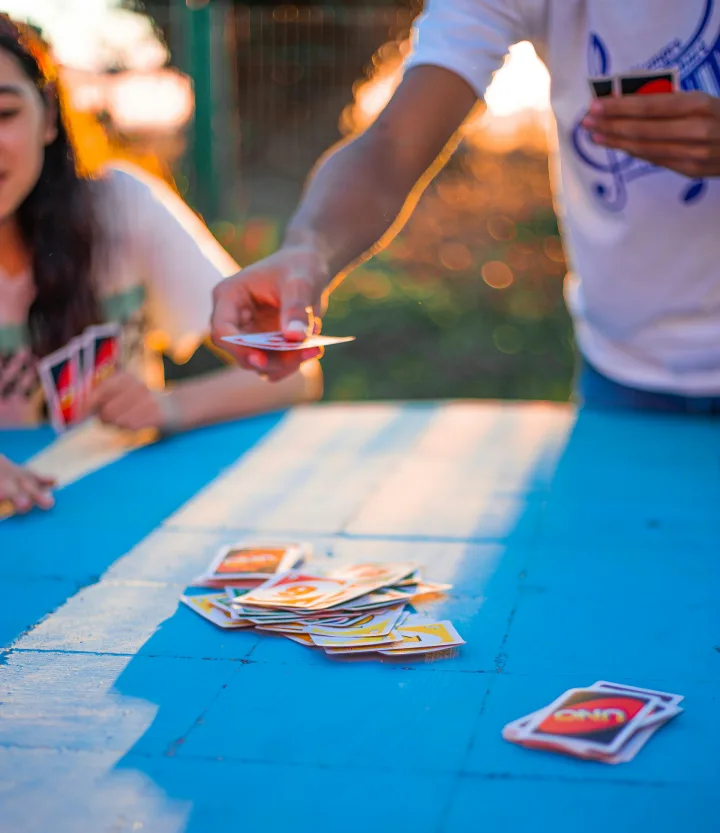
You sit down to play a game with a friend. It’s supposed to be casual - just something to do together for a while. Then they win.
You laugh, tell them well played and insist you’re not bothered. And somehow, five minutes later, you’re already suggesting a rematch.
Games have a funny way of bringing out our competitive side, especially when we’re playing people we actually like. But why does beating a friend feel so satisfying? And why can losing to them feel just a little more annoying than losing to a stranger?
Why does beating a friend feel so good?
Part of the answer is obvious: winning feels good. Games give us a clear goal and immediate feedback. You make a decision, see what happens and find out whether you came out ahead.
That kind of feedback is unusual in everyday life. You might be good at your job, a great cook, but there usually isn’t a scoreboard telling you exactly how you did. Games create one.
And when the person you're playing is a friend, the result can feel more meaningful. You’re not just winning a game. You’re beating someone whose abilities you know and whose opinion you probably care about.
Especially if they’ve beaten you before.
We naturally compare ourselves to people close to us
We humans are constantly comparing ourselves to other people. But we don’t compare ourselves equally with everyone we meet.
Friends make particularly interesting comparison points because they’re close enough to us to feel relevant. You might have similar interests, similar experience or simply know each other well enough to have a sense of what the other person is capable of.
So if your friend suddenly turns out to be much better than you at something, it can feel like useful information about yourself. Apparently, they’re better at this than I am.
That little gap can be surprisingly motivating. You want to close it.
Games turn social comparison into something harmless
Most of the time, we don’t get a clear answer to the question of how we compare with the people around us. Games solve that problem rather neatly.
There’s a defined challenge, a set of rules and an outcome. Someone wins and someone loses. You can see what happened without having to argue about it.
That makes games a tiny, contained version of competition. You get to test yourself against another person at low stakes. That’s a pretty useful combination.
Why rivalry can be more fun with friends
There’s also something different about competing with someone you know well. You remember what happened last time. You know their habits, their favourite moves and the things they’re particularly good at.
Maybe your friend always takes ridiculous risks, they play incredibly defensively, or you’ve been trying to beat them at the same game for years.
That history can turn ordinary competition into a rivalry.
A rivalry doesn’t necessarily mean you dislike someone. In fact, some of our favourite rivalries are with people we genuinely enjoy spending time with. The relationship gives the competition a story, and the competition gives the relationship another way to play out.
You’re not just playing the game. You’re playing them.
Backgammon adds an interesting twist
Backgammon is a particularly good example because it combines decision-making with luck.
You can make a strong strategic decision and still get a terrible roll. Your friend can make a questionable move and somehow roll exactly what they need. A game that looked comfortably in your favour can change in a single turn.
That uncertainty makes the competition more engaging because you never have complete control over the outcome. You have to make the best decision you can, then react to what happens.
And when your friend gets that perfect roll? Well, obviously they were lucky.
Why do we want a rematch after losing?
Losing to a friend can create a very specific feeling: I could have won that.
Maybe you made one bad decision. Maybe you missed an opportunity. Maybe the dice were spectacularly unfair. Whatever the reason, the result leaves you with something to prove - even if the only person you need to prove it to is yourself.
A rematch offers the possibility of a different outcome. You can try the strategy again, avoid the mistake you made last time or simply see whether you can do better. That sense of unfinished business can be surprisingly motivating.
And sometimes, of course, you just want revenge. Friendly revenge. Completely reasonable revenge.
Competition can actually strengthen friendships
As long as the competition stays friendly, games give us a surprisingly good way to interact.
You can tease each other, challenge each other and celebrate ridiculous wins. You can complain about the dice, laugh at a terrible move and bring up what happened in the last game the next time you play.
The important thing is that you both understand the boundaries. You can care about winning without making winning more important than the friendship.
In fact, the competition can become part of what makes the friendship fun.
Think about the friends you’ve played games with over the years. You probably remember particular moments: the unbelievable comeback, the game that went on forever, the time someone refused to admit they were losing.
You think the memories are about the game, when really they’re about the people.
Maybe that’s why we like it
When we get competitive with our friends, we’re not necessarily trying to prove that we’re better than them.
We’re testing ourselves against someone who matters to us, in a setting where the stakes are low and the rules are clear. We get the satisfaction of winning, the motivation to improve when we lose and the chance to share an experience that is a little more exciting than simply sitting around talking.
And there’s something nice about that.
You can spend an evening being completely invested in beating your friend at backgammon, chess, cards or Mario Kart and then go back to being friends as soon as the game is over.
Until the rematch, obviously.
Fancy a game?
No password, no download - and your opponent can take their turn tomorrow.
Play in your browser
Angela
One of the top 10 sweetest people, probably. German by birth, delightfully unserious by nature. By day, she shapes stories; by night, she beats her boyfriend at backgammon and writes poetry.