
 bearoff
How to set up a backgammon board
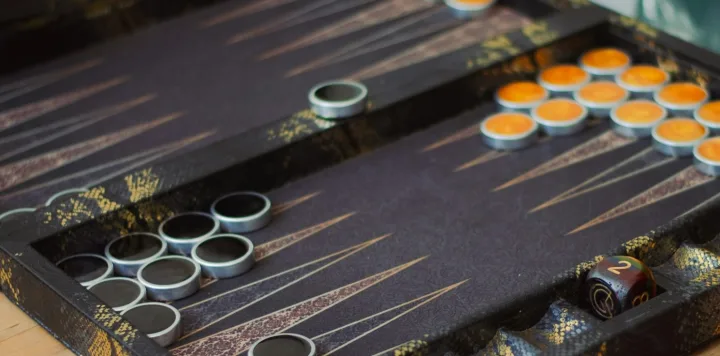
Five, three, five, two. Then you'll never need to look it up again.
Two minutes, and you'll never need to look it up again. There's a pattern hiding in the starting position, and once you see it you'll remember it.
What you're looking at
The board has 24 narrow triangles, called points, twelve on each side. The raised ridge down the middle is the bar.
Each player's points are numbered 1 to 24, counting from their own home board outwards. Your 1-point is the furthest corner of your home board; your 24-point is diagonally opposite, in your opponent's home board. Here's the part that confuses everyone at first: your 1-point is your opponent's 24-point. Same triangle, two names, depending on who's counting.
Your home board is points 1 to 6, the quadrant where your checkers finish.
The starting position
Each player has fifteen checkers, placed like this:
- Five checkers on your 6-point
- Three checkers on your 8-point
- Five checkers on your 13-point
- Two checkers on your 24-point
Your opponent's checkers mirror yours exactly, so every stack of yours faces a stack of theirs across the board.
The easy way to remember it
Two numbers, then the pattern falls out: 5, 3, 5, 2 on the 6, 8, 13 and 24.
Or if you'd rather remember it by shape: two big stacks of five, one short stack of three in between, and a lonely pair in the far corner. The pair are the two that have the whole board to cross, which is exactly why they cause so much trouble later.
Which way do the checkers go?
Yours travel from the high numbers to the low ones, finishing in your home board. Your opponent's go the opposite way, towards theirs.
It doesn't matter which side of the board your home is on, as long as both players agree before the first roll. What does matter is that your home board and your opponent's are at the same end of the board, facing each other.
The rest of the kit
- Two dice each, or one pair shared, depending on how you play.
- A doubling cube, the big six-sided block marked 2, 4, 8, 16, 32 and 64. Beginners often leave it to one side for the first few games, which is fine.
- A cup for shaking the dice, if you have one. It stops the clatter and it stops arguments.
If the board came with a tube of checkers and you're missing one, count them: fifteen each, thirty in total. It's the most common thing to lose.
The short version
- 24 points, twelve a side, with the bar down the middle.
- Number them 1 to 24 from your own home board outwards.
- Five on the 6, three on the 8, five on the 13, two on the 24.
- Your opponent's position mirrors yours.
- Your checkers run from high numbers down to your home board.
- Fifteen checkers each, two dice and a doubling cube.
Fancy a game?
No password, no download - and your opponent can take their turn tomorrow.
Play in your browser
Angela
One of the top 10 sweetest people, probably. German by birth, delightfully unserious by nature. By day, she shapes stories; by night, she beats her boyfriend at backgammon and writes poetry.